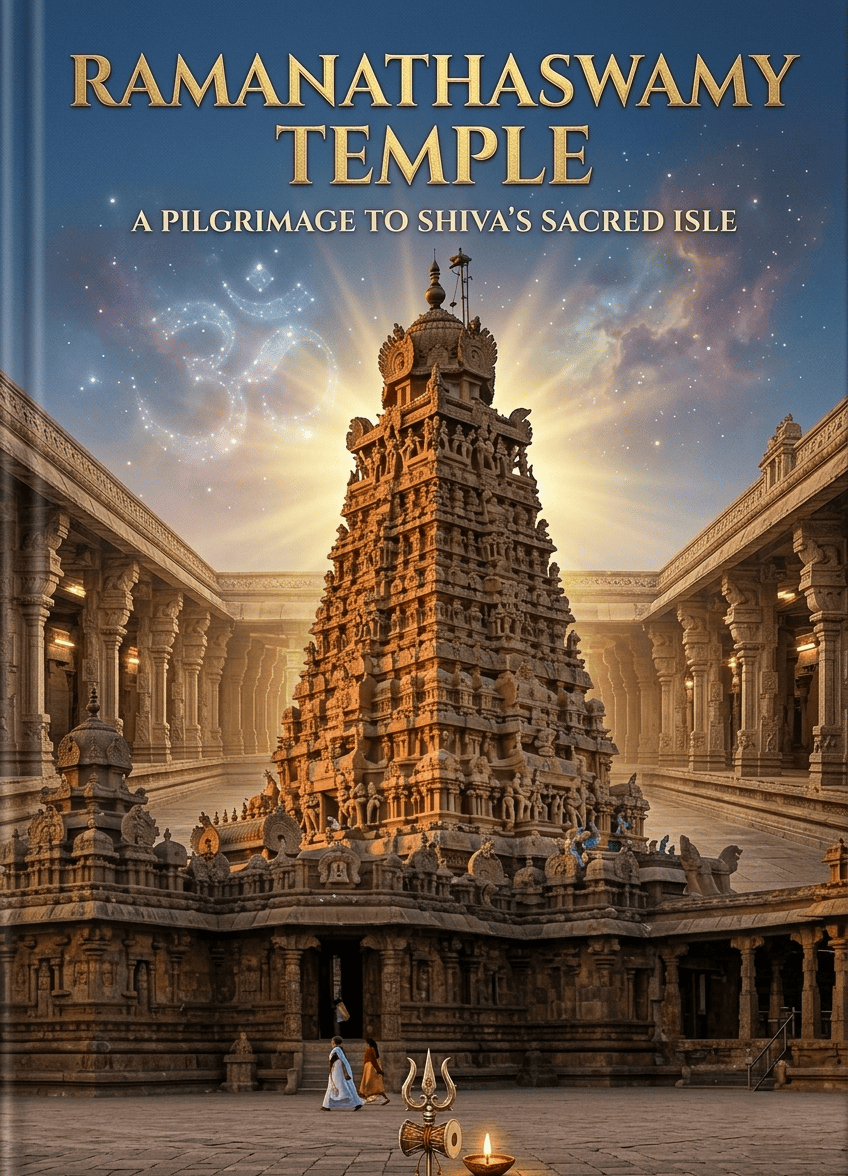
SHRI
RAMESHWARAM JYOTIRLINGA
CHAPTER ELEVEN
Om Namah
Shivaya
---------------------------
INTRODUCTION
"Salutations
to Lord Ganesha. Today, I narrate to you the wonderful story of Rameshwaram –
the eleventh among the twelve Jyotirlingas."
This is not
merely a story – it is the tale of righteousness and humility, the tale of the
oneness of Rama and Shiva, and that divine play of Lord Rama's devotion to
Shiva, which teaches us – even before a righteous war, the Lord himself
performs Shiva worship, and one who seeks refuge in Shiva is assured of victory.
-----------------------------
CHAPTER ONE
RAMESHWARAM
– THE LORD OF RAMA
"Rameshwaram"
– meaning "the Lord of Rama" – the Shiva established by Lord Rama
himself.
This is the
sacred place where Lord Rama himself performed Shiva worship. This is the symbol
of the oneness of Shiva and Vishnu.
"Rameshwaram
– where Shiva worshipped in the form of Rama, and Rama worshipped in the form
of Shiva. This place is a wonderful testament to the unity of Vishnu and
Shiva."
----------------------------
CHAPTER TWO
RAMESHWARAM –
SHIVA'S ABODE ON THE SEASHORE
The
Rameshwaram Jyotirlinga is located on the Rameshwaram island in the state of
Tamil Nadu.
It is
situated on Pamban Island – which lies between India and Sri Lanka.
It is built
at the confluence of the Bay of Bengal and the Indian Ocean.
This holds
the eleventh position among the twelve Jyotirlingas.
This is the
southern dham among the four Char Dhams.
-------------------------
CHAPTER
THREE
THE RAMAYANA
ERA – LORD RAMA ON THE SEASHORE
When Lord
Rama was advancing towards Lanka in search of Sita, he arrived at the seashore
of Rameshwaram.
There he saw
– the vast ocean was obstructing his path. To reach Lanka, it was necessary to
build a bridge (setu) over the ocean.
"Rama
looked at the ocean and thought – 'I am about to go to war, which will involve
violence. Therefore, I shall first worship Shiva and seek his grace.'"
----------------------------
CHAPTER FOUR
THE DECISION
TO WORSHIP SHIVA – SENDING HANUMAN TO KAILASH
Lord Rama
sent his supreme devotee Hanuman to Mount Kailash –
"O
Hanuman! Go to Kailash and bring the Atmalinga of Lord Shiva. I wish to perform
Shiva worship here."
Hanuman ji
set off towards Kailash. He flew to Kailash and asked Lord Shiva for the linga.
Shiva gave
Hanuman a linga and said –
"When
this is placed on the ground, it will become fixed."
-------------------------
CHAPTER FIVE
SITA'S SAND
LINGA – THE DELAY AND THE NEED
Hanuman was
delayed in returning from Kailash. The auspicious time for the puja was approaching.
Lord Rama
said to Sita –
"Devi!
Hanuman has been delayed. The time is passing."
Then Mother
Sita made a Shivalinga from the sand on the seashore.
Lord Rama
worshipped that sand linga and established it as Shiva.
"This
came to be known as the 'Ramalinga' or 'Rameshwaram' Jyotirlinga."
---------------------------
CHAPTER SIX
HANUMAN'S
DISAPPOINTMENT – THE DISPLACEMENT OF THE LINGA
When Hanuman
returned with the linga from Kailash, he saw – Rama was already worshipping a
Shivalinga.
Hanuman ji
was very disappointed. He thought –
"I brought
the linga from so far away for my Lord – but he could not wait for me."
Lord Rama
understood Hanuman's feelings and said –
"O
Hanuman! Establish this linga as well. It shall be called the 'Hanumat
Linga'."
----------------------------
CHAPTER
SEVEN
TWO LINGAS –
THE RAMALINGA AND THE HANUMAT LINGA
There are
two main Shivalingas in Rameshwaram –
1. Ramalinga
(Rameshwaram) –
Made of sand
by Mother Sita.
This is the
main Jyotirlinga.
It is
considered the self-manifested form of Shiva.
2. Hanumat
Linga –
Brought from
Kailash by Hanuman ji.
It is
located to the south of the main Jyotirlinga.
It is
believed – the pilgrimage to Rameshwaram remains incomplete without having
darshan of the Hanumat Linga.
"Rameshwaram
– where two lingas – the Ramalinga and the Hanumat Linga – reside. Both are
symbols of devotion and love."
--------------------------------
CHAPTER
EIGHT
RAMESHWARAM
– THE ONENESS OF VISHNU AND SHIVA
Rameshwaram
is the greatest symbol of the oneness of Shiva and Vishnu –
"Where
Rama (the incarnation of Vishnu) worships Shiva, there Shiva himself manifests
as Rama."
This place
teaches us –
"There
is no difference between Shiva and Vishnu. Both are two forms of the same
Supreme Brahman."
------------------------------------------------------------
CHAPTER NINE
THE DIVINE
HISTORY OF THE TEMPLE
Mythological
Belief –
Rameshwaram
is mentioned in –
The Ramayana
– where Rama performed Shiva worship
The Padma Puran
– which describes the glory of this place
The Shiva Puran
– which lists Rameshwaram among the Jyotirlingas
Historical
Background –
The temple
was completed in the 12th century.
The Pandya
kings got the temple constructed.
Sardar
Vallabhbhai Patel got a road built to the temple in 1947 – making the journey
easier.
-----------------------------
CHAPTER TEN
THE TEMPLE'S
ARCHITECTURE AND SPECIAL FEATURES
The
architecture of the Rameshwaram temple is grand and unique.
Temple
Structure –
Style –
South Indian (Dravida) style
Enclosure –
Massive, 1200 meters long
Mandapa –
The Sahasrastambha Mandapa with 1000 pillars
Gopuram – 9
gateways, the tallest being 38 meters
The
1000-Pillar Mandapa –
This temple
is famous for its 1000 pillars. These pillars are made of granite stone and
have exquisite carvings.
22 Sacred
Tanks (Teerthas) –
The temple
complex has 22 sacred water bodies – which are called "Teerthas".
1. Agni
Teertha – destroys sins, located on the seashore
2. Koti
Teertha – for offering oblations to ancestors
3. Ganga
Teertha – equivalent to a dip in the Ganga
4. Yamuna
Teertha
5. Brahma
Teertha – for Brahma worship
6. Sita
Teertha – Sita's bathing place
"It is
believed – bathing in these 22 Teerthas destroys all sins."
-----------------------------
CHAPTER
ELEVEN
THE RAMESHWARAM
PILGRIMAGE – THE RITUALS
Bathing in
the 22 Teerthas –
Bathing in
the 22 Teerthas is considered essential in the Rameshwaram pilgrimage –
"One
who bathes in the 22 Teerthas has his sins of many lifetimes destroyed."
Offering
Oblations to Ancestors –
Offering
oblations (tarpana) to ancestors at Rameshwaram is considered extremely meritorious.
Rudrabhishek
–
Rudrabhishek
and japa on the Shivalinga – these are the main rituals here.
------------------------------------------------------------
CHAPTER
TWELVE
SETU
SAMUDRAM – THE WONDERFUL MYSTERY OF RAMA SETU
The Rama
Setu (Adam's Bridge) lies between Rameshwaram and Sri Lanka.
What is the
Rama Setu? –
It is a
chain of limestone shoals.
It connects
Sri Lanka to India.
It is
visible even from satellites.
Where did it
come from? –
The Ramayana
describes – the army of monkeys built the bridge.
Nala and
Nila wrote Rama's name on the stones and made them float on water.
"This
remains a mystery for scientists and archaeologists."
--------------------
CHAPTER
THIRTEEN
INTERESTING
FACTS
First –
Rameshwaram is one of the 12 Jyotirlingas located in the southern direction.
Second – It
is one of the four Char Dhams – established by Adi Shankaracharya.
Third –
There are two Shivalingas here – the Ramalinga and the Hanumat Linga.
Fourth – The
temple has a massive mandapa with 1000 pillars.
Fifth –
There are 22 sacred tanks (Teerthas) here.
Sixth – The
Rama Setu (towards Sri Lanka) is visible from here.
Seventh –
Rameshwaram is also called the Kashi of the South.
------------------------------------------------------------
CHAPTER
FOURTEEN
THE
SPIRITUAL MESSAGE – THE ESSENCE OF THE STORY
This story
carries a deep spiritual meaning –
1. Humility
–
Lord Rama
himself performed Shiva worship before going to war – this teaches – no matter
how great a warrior one may be, one must be humble before God.
2. The
Oneness of Shiva and Vishnu –
Rama (the
incarnation of Vishnu) worships Shiva – this teaches – there is no difference
between Shiva and Vishnu. Both are the same Supreme Brahman.
3. Righteous
War –
Rama
performed Shiva worship before the war – this teaches – any great endeavour
should be begun with Shiva's grace.
4. The Power
of Devotion –
Hanuman's
devotion and Rama's grace – this teaches – with devotion and faith, anything is
possible.
-----------------------------
CHAPTER
FIFTEEN
CONCLUSION
This story
of the Rameshwaram Jyotirlinga teaches us –
"One
who seeks refuge in Shiva is assured of victory. Rameshwaram – where Rama
himself performed Shiva worship, where Hanuman brought the linga from Kailash,
where the wonderful mystery of Setu Samudram lies – this place is a wonderful
confluence of righteousness, devotion, and the oneness of Shiva and
Vishnu."
Whoever
remembers Rameshwaram with devotion, attains victory in righteousness, Shiva's
grace, and salvation – all three.
This is the
story of Rameshwaram... this is the glory of the eleventh Jyotirlinga.
Om Namah
Shivaya.
Jai
Rameshwaram.
Jai Shri
Rama.
— The End —